Overcoming Flow Exporter Limitations with PacketRanger

NetFlow is the lifeblood of modern network operations, providing crucial insights for everything from traffic analysis and capacity planning to robust security threat detection. Yet, many organizations hit a wall when their NetFlow exporters struggle to keep pace with high-traffic environments and the escalating demands for detailed flow data.
NetFlow exporter limitations primarily revolve around the amount of detail that can be packed into a flow tuple, the impact on network performance, and the limitations of traditional NetFlow versions, such as the limited number of destinations for each flow cache. These issues often arise when an organization is trying to do too much with NetFlow than a single networked device can manage, especially in high traffic environments.
Imagine your network data as a bustling highway. Traditional NetFlow exporters are like single-lane exits, capable of directing traffic to only a few destinations. This quickly becomes a bottleneck when multiple applications, each with unique data requirements, need access to the same flow information.
The widespread adoption of NetFlow across diverse IT functions necessitates the consumption of flow data by numerous applications. Consequently, replicating flow data to multiple destinations becomes a crucial requirement. Similarly, for applications that require unique flow data, it may be necessary to configure multiple flow monitors and exporters on the device. This configuration can significantly degrade the device’s performance.
This is also problematic for two reasons. First, NetFlow can only forward flow data to a limited number of flow collectors. Second, this often leads to network congestion and resource constraints on the source node.
NetFlow v5 Limitations and Issues
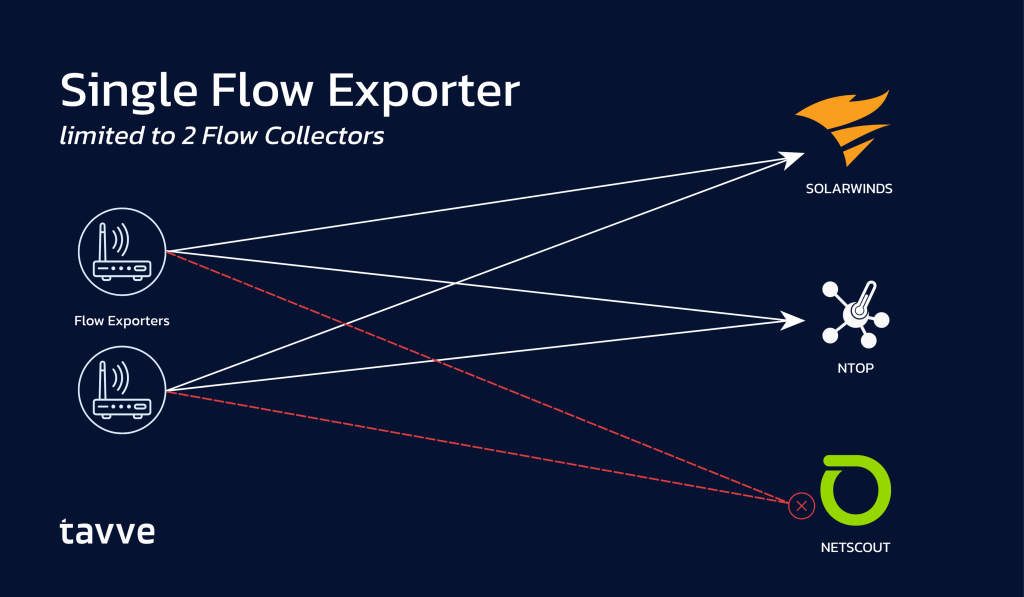
NetFlow v5, the most widely adopted version of NetFlow, is limited to exporting flow data to two flow collectors per flow cache.
A common workaround involves configuring additional flow monitors on the device, but this approach impacts device performance, as previously mentioned. Additionally, this workaround will increase the amount NetFlow data across the network, which can lead to network congestion and NetFlow packet loss.

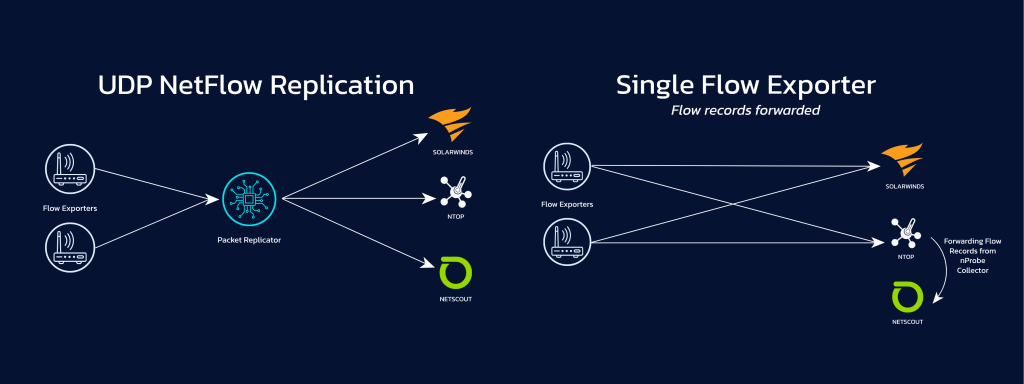
An alternative solution is to replicate the NetFlow UDP packet, typically achieved using a rudimentary and poorly designed packet replicator or forwarding flow records from a separate flow collector. However, these solutions often lack the features, performance, availability, and ease of use that many organizations require.
For example, simply replicating NetFlow packets from a flow monitor that captures network flows for security threat detection may not be appropriate for a separate application that performs link utilization and capacity planning. This increases the number of flows that each application must process, which increases costs that result from the additional compute resources and flow-based licenses.
Flexible NetFlow Limitations and Issues
Recent advancements of NetFlow, particularly version 9 (Flexible NetFlow) and later, enable users to configure custom templates allowing for more tailored network traffic analysis and reporting. It also enables the configuration of multiple flow collectors for a single flow monitor. A flow monitor can accommodate up to ten exporters, each responsible for sending flow data to a distinct collector. These improvements address many of the limitations encountered in NetFlow v5. However, they introduce a new layer of complexity.
In contrast to NetFlow v5, which employed a fixed template with seven field identifiers, Flexible NetFlow’s dynamic templates can accommodate thousands of distinct field identifiers. While the initial NetFlow v9 RFC specified 79 fields, the 16-bit field identifier permits 65,536 potential values. This enables vendors to develop custom NetFlow templates with unique field identifiers tailored to their equipment, such as fields for firewalls that contain threat ID’s and other distinctive information generated by these devices.
On the surface, this flexibility seems like a major leap forward. Yet, dynamic templates make standardizing NetFlow configurations virtually impossible. Each device type demands its own unique configuration, requiring users to meticulously specify the subset of fields relevant to each intended flow collector. This creates disparity between device configurations, necessitates frequent alterations, and significantly increases the likelihood of human error, leading to poor compliance and hindering troubleshooting efforts across the network.
The Ideal Solution – Telemetry Broker for NetFlow
The ideal approach is to configure a single flow exporter that directs all flow records to a highly available NetFlow broker. This strategy drastically minimizes resource consumption on the source node and reduces the volume of data traversing the network’s management plane. Crucially, this NetFlow broker must be more than a simple replicator; it needs intelligent filtering capabilities.
With an intelligent broker like Tavve’s PacketRanger, each NetFlow analyzer receives only the flow records pertinent to its specific purpose—be it threat detection, bandwidth utilization, or IP accounting. This precision reduces the number of flows each analyzer must index and process, leading to improved application performance, optimized flow-based licenses, and a significant reduction in compute resource requirements.

Tavve’s PacketRanger and ZoneRanger are engineered to directly tackle these prevalent NetFlow challenges. Our solutions boast an astonishing processing capability of 3 million flows per second on a single node. With an intuitive user interface and an efficient workflow, managing your NetFlow telemetry pipelines becomes effortless.
Our robust filtering capabilities allow for unparalleled optimization of flow data. With over 480 pre-defined filter criteria and the flexibility to add custom fields for Flexible NetFlow, you can craft tailored NetFlow pipelines that grant you enhanced control over the distribution of flow data across your Flow Collectors. This not only optimizes applications utilizing flow-based licenses but also streamlines your entire network monitoring strategy.
If you’re grappling with flow exporter limitations, frustrated by flow loss and congestion, perplexed by flow duplication, or simply weary of unnecessary expenses to expand your flow-based licenses, it’s time for a change. We invite you to contact Tavve and schedule a demo to see how PacketRanger and ZoneRanger can transform your NetFlow operations.
